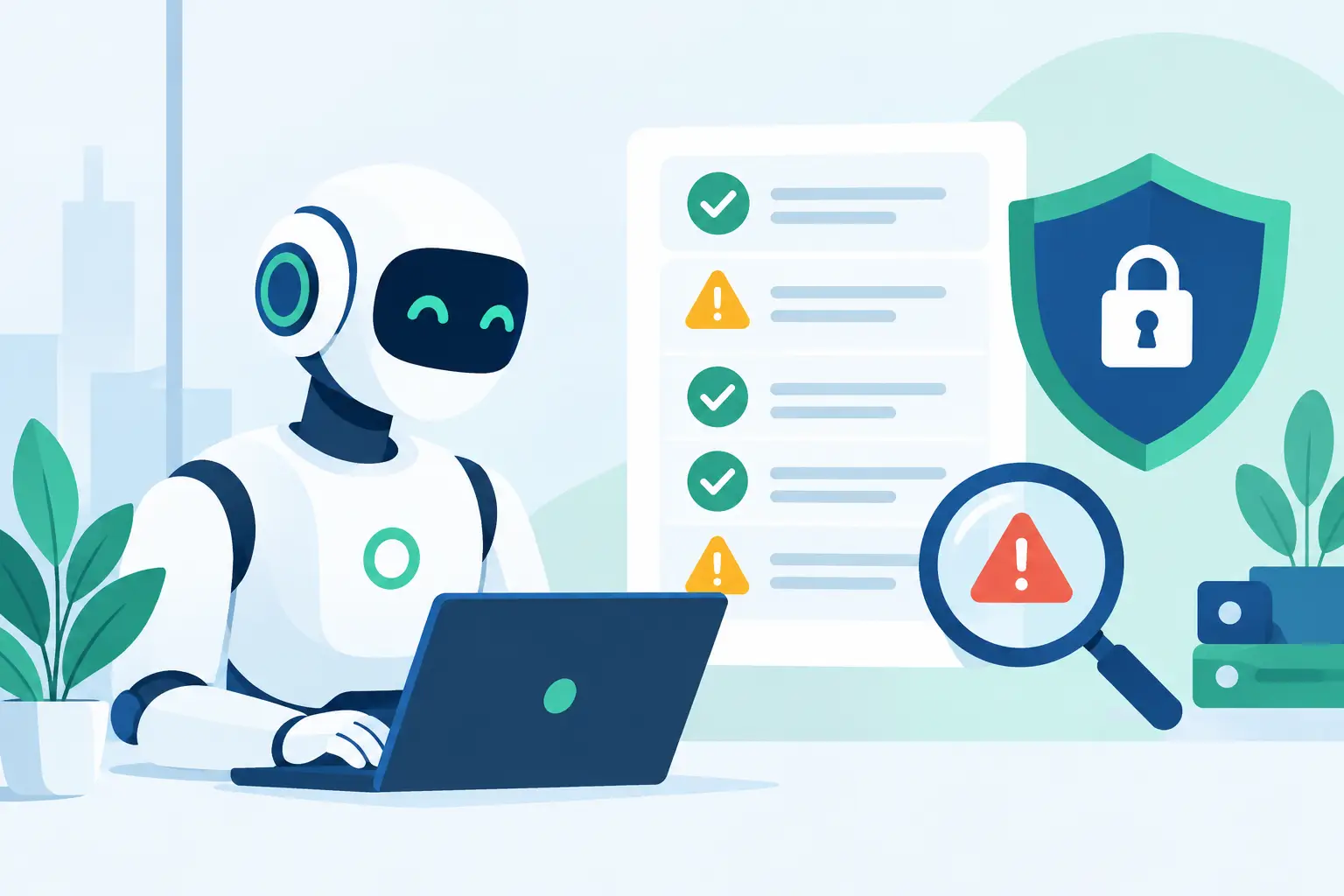
A missed privacy clause, an unsupported marketing claim or an overdue right-to-work check can create a problem long before a founder sees it. For lean teams moving quickly, the question is not whether compliance matters. It is whether can AI identify compliance risks early enough to prevent expensive rework, customer distrust or regulatory action.
The practical answer is yes - within clear limits. AI can scan large volumes of business material, spot patterns that deserve attention and turn a vague concern into a focused action list. It cannot replace qualified legal, tax, HR or regulatory advice where a decision requires professional judgement. Used properly, though, it gives smaller businesses something they rarely have: an always-available first line of review.
Can AI Identify Compliance Risks Reliably?
AI is strongest when the risk is visible in the information you provide. Give it a supplier agreement, customer terms, job advert, privacy policy, email campaign, employee handbook or sales process, and it can compare that material against a defined set of requirements and flag inconsistencies.
For example, an AI review can highlight that a website form asks for personal data without clearly explaining why it is collected. It can identify contract language that conflicts with your payment process, detect potentially misleading wording in an advert, or point out that a new contractor arrangement raises employment-status questions. These are not final legal findings. They are high-value prompts to investigate before the issue reaches a customer, regulator or tribunal.
This matters because compliance failures are often operational failures in disguise. A founder may know that data protection rules apply, but a new lead magnet gets launched on a Friday afternoon without the right consent wording. An agency may have sensible client terms, yet its account managers promise timelines or deliverables that sit outside those terms. AI can help surface the gap between policy and practice.
Reliability depends on three factors: the quality of the source material, the clarity of the question and the rules against which the material is assessed. Vague prompts produce vague answers. A focused request such as, “Review this customer onboarding flow for UK GDPR risks and list the evidence we should retain,” produces a more useful working output.
Where AI Delivers Immediate Value
Most small businesses do not need an abstract compliance programme. They need to know where they are exposed this week, what requires specialist review and what their team can fix immediately.
Reviewing documents before they create liabilities
AI can perform a rapid first-pass review of contracts, policies, proposals and supplier documentation. It can identify missing definitions, unclear responsibilities, automatic renewal terms, weak limitation-of-liability language, inconsistent dates and obligations that your business may struggle to meet.
For a SaaS business, this might mean checking whether a data processing schedule reflects how the product actually handles customer data. For an e-commerce operator, it might mean reviewing returns wording, pricing statements and promotional terms. For an employer, it could mean checking whether a policy is consistent with current working arrangements.
The gain is speed, not a substitute for a solicitor. Instead of sending every document to an adviser with no context, you can arrive with a cleaner brief and a shortlist of precise questions. That reduces cost and shortens the route to a decision.
Monitoring communications and claims
Compliance risk often appears in everyday copy: social posts, sales emails, landing pages, product labels and pitch decks. Teams under pressure tend to overstate outcomes, use unverified comparisons or make broad claims such as “guaranteed”, “best” or “fully compliant”.
AI can review proposed messaging against your own evidence standards. It can flag claims that need substantiation, identify missing qualifications and suggest safer wording without draining the commercial force from the message. This is particularly useful where several people produce customer-facing content and no one owns final sign-off.
It also helps maintain consistency. A business cannot credibly state one position in its privacy policy, another in a sales call and a third in an onboarding email. AI can compare those materials and expose contradictions that a busy operator may miss.
Building controls into repeatable work
The real value is not merely finding a problem once. It is using AI to create a repeatable check before work goes live.
A growing business can build simple review points into common workflows: new supplier onboarding, campaign approval, product launches, hiring, contract changes and customer-data access. At each point, AI can ask the questions that experienced operators ask: What data is involved? Who has approval authority? What commitments are being made? What evidence should be retained? Which part needs external advice?
This turns compliance from a last-minute scramble into an operating discipline. It also protects founders from becoming the only person who remembers how things should be done.
The Limits You Should Not Ignore
AI can sound decisive even when the facts are incomplete. That is why it should be treated as expert-structured support, not as the final authority on legal or regulatory obligations.
Rules vary by sector, jurisdiction, contract terms and the detail of a situation. Financial promotions, employment disputes, health and safety incidents, tax treatment, regulated services and complex data transfers can carry consequences that demand specialist input. A model may identify the issue, but it cannot inspect your full evidence trail, interpret a regulator’s current enforcement position or accept liability for the decision.
There is also a confidentiality question. Do not paste sensitive customer data, commercially restricted contracts or employee information into a tool unless you understand its data handling, permissions and retention settings. Your AI process should meet the same standards you expect from every other supplier handling business information.
Finally, AI can only assess what it sees. A perfectly drafted policy does not prove that staff follow it. Combine document review with real operational checks: access controls, training records, approval logs, incident reporting and regular manager conversations.
How to Use AI for Compliance Without Losing Control
Start with the areas where volume is high, errors are common and the financial downside is meaningful. For many SMEs, that means customer data, employment documentation, contracts and marketing claims.
First, define the outcome. Do you need a risk scan, a document comparison, a pre-launch checklist or a plain-English explanation of an obligation? Then provide the relevant context, including your business model, customer type, location and internal policy. Ask for risks to be ranked by impact and urgency, rather than requesting a generic summary.
Next, require a useful format. Ask AI to separate immediate fixes from items that need specialist advice. Ask it to state what assumption it has made and what evidence is missing. This prevents a polished response from being mistaken for certainty.
A practical review prompt might ask for four outputs: the potential risk, why it matters, the exact wording or process causing concern, and the next action. That structure makes the output suitable for a founder, operations lead or department owner to act on.
Then assign ownership. Every flagged item needs a named person, a deadline and a decision record. If an issue is accepted rather than fixed, document why. Good compliance management is not about eliminating every risk. It is about making informed choices and proving that choices were made responsibly.
RPM ReallyDoing.It is designed around this kind of executive thinking: giving operators structured support across legal-style review, finance, strategy and execution, without forcing them to become specialists in every discipline. The goal is faster, better-framed decisions - with professional advice brought in at the point it is genuinely needed.
A Better Question Than “Are We Compliant?”
No business remains permanently compliant through a single audit. Products change, teams grow, regulations evolve and the shortcuts that helped you move quickly can become weaknesses later.
A stronger question is: “Where could our current way of working create avoidable exposure?” AI is well suited to helping answer it repeatedly, across the documents, decisions and communications that accumulate as a business grows.
Use it to spot issues earlier, organise the facts, improve your internal controls and make external expert time count. Keep human judgement in charge where the stakes are high. That is how a lean business gains more control without building a costly compliance department before it needs one.