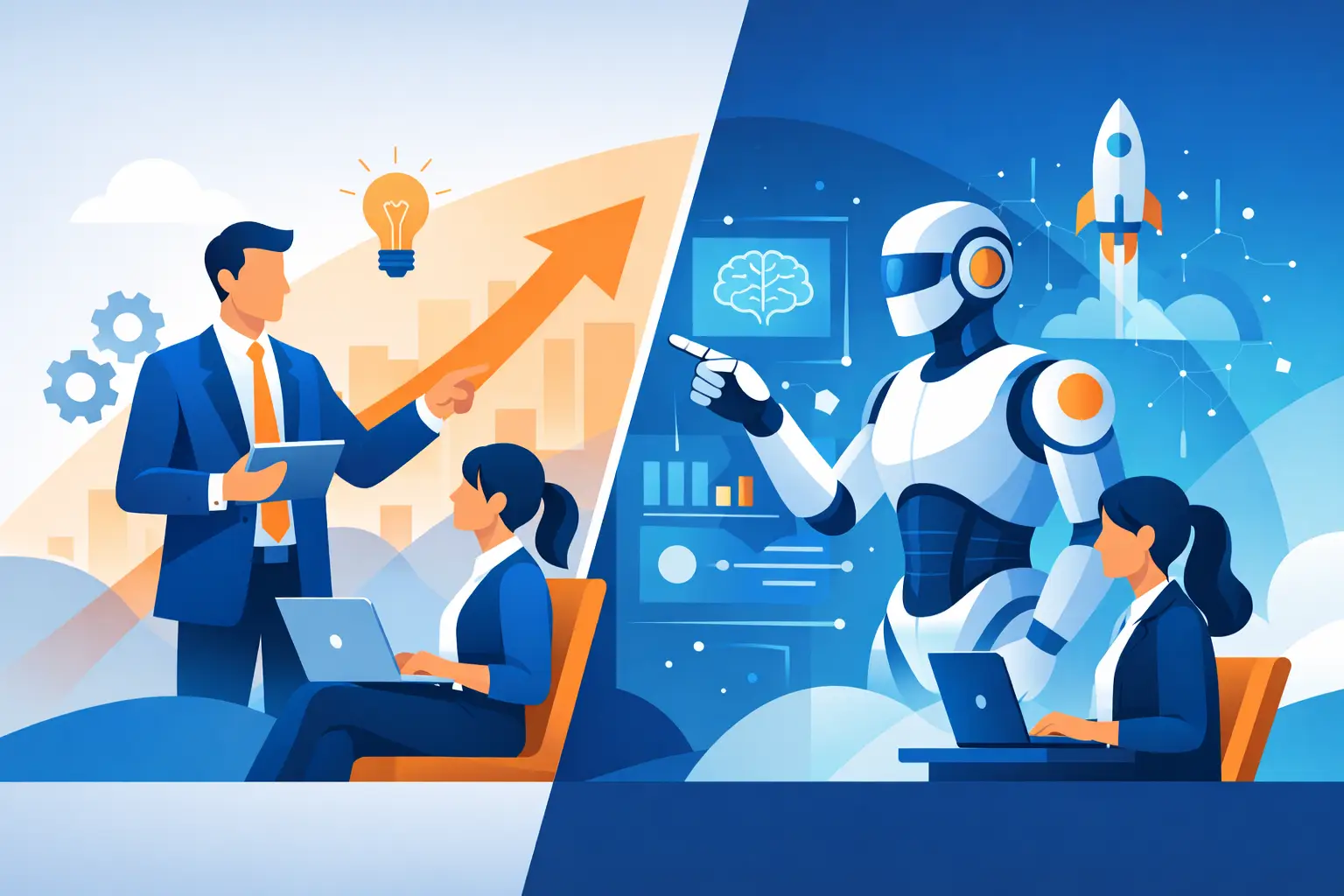
A key hire has fallen through, cash flow is tightening, and a campaign needs approval before close of business. You need a clear decision now, not a diary slot three weeks from Friday. That is the real business coach vs AI question for founders: which form of support helps you make better moves at the pace your business demands?
A business coach can bring perspective, challenge and accountability. AI can provide immediate, structured support across strategy, marketing, finance and execution. Neither is automatically the better choice. The right answer depends on the decision in front of you, the stage of your business and whether your main constraint is judgement, speed, budget or follow-through.
Business coach vs AI: the practical difference
A business coach is a human adviser who helps you think through goals, obstacles and behaviour. The strongest coaches ask difficult questions, spot recurring patterns and hold you accountable for commitments you have avoided. Their value often comes from context: they can read the room, understand your leadership style and challenge assumptions based on lived commercial experience.
That relationship has limits. Coaching is usually scheduled, scoped around a particular specialism and priced accordingly. If you need help with pricing on Monday, a sales objection on Tuesday, a cash-flow forecast on Wednesday and a contract clause on Thursday, one coach may not cover every issue. You may end up paying for separate experts, waiting for replies or making decisions without support.
AI business support works differently. It is available when the question appears, including the untidy questions that arise during a supplier call or halfway through writing a proposal. Used well, it gives you a structured starting point: options, assumptions to test, calculations to check, messaging to refine and a practical next action.
The distinction is not simply human versus technology. It is scheduled, relationship-led guidance versus on-demand, repeatable operational support. For a lean team, that difference affects momentum.
Where a business coach earns their place
There are moments when a capable human coach is difficult to replace. If you are working through founder conflict, confidence after a setback, a major leadership transition or a personal pattern that keeps affecting business performance, the human relationship matters. A coach can notice hesitation, challenge the story you are telling yourself and create accountability that feels personal.
A coach may also be the right investment when their specific experience is unusually relevant. A founder who has successfully scaled in your sector, sold a similar company or navigated the exact operational challenge you face can bring valuable judgement. The point is not that every experienced coach has the answer. It is that high-quality experience can help you avoid an expensive blind spot.
But be clear about what you are buying. Coaching can sharpen your thinking, but it is not automatically a substitute for a finance lead, marketing strategist, sales operator or legal professional. Ask what practical output you will receive between sessions, how quickly you can access support and whether the advice translates into action for your team.
Where AI creates an unfair speed advantage
Most small businesses do not fail because the owner lacks ideas. They lose time switching between roles, second-guessing decisions and starting every task from a blank page. AI is particularly useful when the work needs structure and speed rather than a lengthy conversation.
For example, an e-commerce operator can use AI to pressure-test a promotion before cutting margin. An agency owner can turn a vague prospect brief into discovery questions, a proposal outline and a follow-up sequence. A SaaS founder can model pricing scenarios, clarify positioning and create a board-ready update without waiting for several specialists to respond.
The commercial advantage is cumulative. Faster access to well-structured thinking means fewer stalled projects, fewer rushed decisions and less expensive context switching. It also makes expert-style support available to the whole team instead of living in one founder's notebook or one consultant's calendar.
That does not mean accepting every answer at face value. AI is only as useful as the information and judgement around it. Give it the real constraints: your margin, capacity, target customer, deadline and risk tolerance. Review the output, test the assumptions and use professional advice where a regulated, legal, tax or employment matter requires it.
Cost is not just the monthly fee
A business coach may charge hundreds or thousands of pounds per month, often with a minimum commitment. For a business at the right stage, that can be money well spent. One timely insight that prevents a poor hire or focuses a stalled leadership team can outweigh the fee.
For many SMEs, though, the issue is not whether coaching has value. It is whether the business can justify paying for limited access to one person while also needing support in several functions. A founder may need strategy this week and marketing, financial planning or sales support next week. The fragmented model becomes costly quickly.
AI changes the economics by making specialised guidance available on demand through a membership model. Rather than hiring a full advisory bench, you can access role-based support when a decision needs moving. This gives smaller businesses more control over spend and more freedom to seek a second view before committing resources.
There is a trade-off. Lower cost does not remove the need for owner judgement. If you want someone to know your history, call you out when you drift from your commitments and personally advocate for you, a human coach offers a different kind of value. If you need frequent, cross-functional support without adding another retainer, AI is often the stronger operating choice.
The accountability question most comparisons miss
People often say they need a coach for accountability. Sometimes they do. Often, they need a clearer operating system.
A weekly conversation can be motivating, but it does not guarantee execution. Accountability improves when priorities are visible, decisions have owners, deadlines are specific and the next action is small enough to start today. AI can support that discipline by converting broad goals into weekly plans, meeting agendas, decision criteria and follow-up tasks.
The best approach is to avoid using either tool as a place to hide. A coach cannot make decisions for you. AI cannot execute a strategy you refuse to implement. Both are most effective when you bring a real problem, choose a direction and act on the next sensible step.
How to choose the right support for your next stage
Start with the bottleneck, not the label. If your problem is isolation, leadership behaviour or a high-stakes relationship, look for an experienced human coach with relevant credibility. If your problem is volume - too many decisions across too many functions, with too little time - on-demand AI support is likely to create faster value.
Consider the frequency of your needs. A monthly strategic session may be enough for a stable business with an experienced leadership team. A founder in growth mode may need support several times a day: reviewing a sales message, checking a budget assumption, building a campaign plan and preparing for a difficult supplier conversation. In that situation, waiting for a session is a hidden operational cost.
Also consider how specialised the question is. Use qualified professionals for matters requiring formal legal, tax, accounting or regulated advice. Use AI to prepare better questions, organise the facts and reduce the time you spend arriving at the point. That makes paid expert time more productive rather than trying to replace it.
A stronger model: AI for daily decisions, people for pivotal moments
For many founders, this is not an either-or choice. AI can be the daily layer of executive support, helping you think, plan, write, analyse and act at speed. A coach can become the higher-value human layer for leadership development, major decisions and personal accountability.
That combination prevents a common mistake: paying human-consultant rates for work that could be structured in minutes, while saving no budget for the moments where human perspective genuinely matters. It also helps your team build capability instead of becoming dependent on a single external adviser.
RPM ReallyDoing.It is built around this practical model, giving entrepreneurs access to specialised AI brains that reflect the questions normally spread across a virtual C-suite. The aim is not generic chat. It is clearer strategy, more confident financial choices, stronger marketing and faster execution when the business needs an answer.
Choose support that matches the speed of your ambition. When the next decision lands, make sure your business has more than good intentions waiting in the diary.