
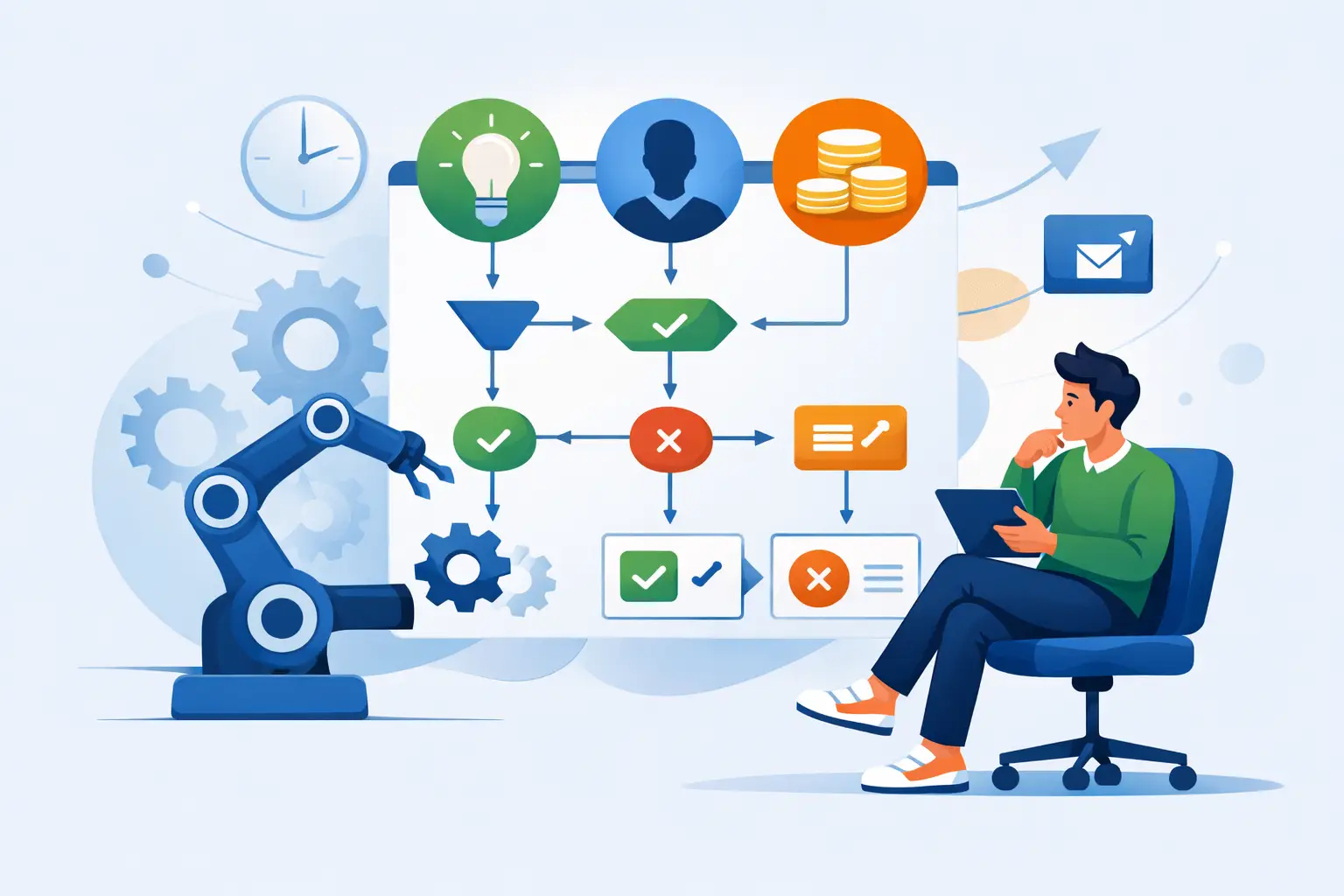
A founder should not need to reconstruct the same decision from scratch every Monday. Yet that is what happens when pricing questions live in Slack, pipeline concerns sit in a spreadsheet, customer feedback is scattered across inboxes, and the final call depends on who has five spare minutes. To automate founder decision workflows is not to hand your company over to software. It is to stop wasting leadership time on gathering, formatting and chasing information that should already be decision-ready.
The aim is simple: give yourself faster routes from signal to action, while keeping human judgement where it creates the most value. For lean companies, that can mean the difference between moving decisively and letting small operational delays turn into missed revenue, slipping margins or team confusion.
Why founder decisions become a bottleneck
Founders are often the final approval point for strategy, spending, hiring, positioning, exceptions and priorities. That is reasonable in the early stages. The problem starts when every question arrives in a different format, with incomplete context and no obvious next step.
A team member asks whether to discount a deal. Another needs approval for a contractor. Marketing wants to test a new audience. Finance flags a cash-flow concern. None of these decisions is necessarily complex on its own. Together, they create a constant stream of context switching that keeps the founder reactive.
The cost is not only slower decisions. It is inconsistent decision quality. If you approve a discount based on instinct one day and reject an almost identical request the next, the business cannot learn a reliable commercial rule. Your team also learns that escalation is safer than ownership.
Automation changes this by creating a repeatable pathway for recurring choices. The pathway collects the right facts, applies agreed criteria, produces a recommendation and records the outcome. You remain accountable, but you are no longer acting as the company’s manual routing system.
Which decisions should be automated first?
Do not start with the decisions that carry existential risk. Board-level fundraising, major restructuring, senior hires and irreversible product bets still require wide context, challenge and leadership judgement. Automation can prepare the material for those calls, but it should not pretend to replace them.
Start with decisions that are frequent, rules-based or prone to delay. Good candidates include approving modest spend, qualifying sales opportunities, deciding whether a customer request fits the roadmap, prioritising marketing experiments, reviewing supplier quotes and responding to routine contract or policy questions.
The best test is practical: if a decision has been made more than five times and the same inputs are needed each time, it is a workflow candidate. If the answer changes dramatically according to personal relationships, hidden political context or a highly unusual set of facts, keep it human-led.
There is a trade-off. Over-automating too early can create bureaucracy disguised as efficiency. A three-person business does not need a seven-stage approval engine for a £100 software subscription. The workflow should be proportionate to the cost, risk and reversibility of the choice.
How to automate founder decision workflows without losing control
The strongest workflow does not begin with an AI prompt. It begins with a decision standard. Before introducing tools, define what a good decision needs to consider and what outcome you are trying to protect.
Take discount approval. A useful workflow is not simply, “Can we offer 15% off?” It asks for contract value, expected margin, deal stage, likelihood of close, customer lifetime potential, competitive pressure and the lowest viable price. It then compares those details against the commercial rules you have already set.
Once that logic is clear, build the process around four parts:
- a consistent intake that captures the facts once;
- a decision framework that applies your policies and commercial thresholds;
- an escalation point for exceptions or higher-risk cases;
- a record of the decision, rationale and result.
This structure matters because it separates information collection from judgement. Your team stops sending vague requests. You stop reopening the same questions. And, over time, you can see whether your rules are actually producing the outcomes you intended.
Build a decision brief, not another form
Most internal forms fail because they demand too much data without explaining why it matters. A decision brief should be short enough to complete quickly and specific enough to support action.
For each workflow, ask for the decision required, the deadline, relevant commercial or operational data, options considered, the recommended route and the likely consequence of waiting. This gives the founder or decision owner a clear basis for approval without a chain of follow-up messages.
AI can turn this raw input into a concise recommendation. It can identify missing information, highlight conflicts with policy, calculate basic scenarios and present risks in plain language. That is particularly valuable when the founder is covering strategy, sales, finance and delivery in the same week.
The point is not to let AI produce a polished answer that nobody checks. The point is to make sure every request arrives with the context required for a confident decision.
Create thresholds that protect speed
Not every choice needs founder sign-off. Define financial, legal-style, customer and brand thresholds that determine who can decide what.
For example, a sales lead might approve a discount within a set margin range, while a larger concession is escalated with a prepared profitability view. A marketing manager might launch tests within an agreed monthly budget, while a new channel requires a strategic case. A delivery lead might resolve routine scope questions, while commitments that affect deadlines or profitability are flagged for review.
Thresholds are not about restricting capable people. They give people permission to act. They also make exceptions visible, which is where founder attention is most valuable.
Review these rules regularly. If nearly every request is escalated, your thresholds are too tight or your team lacks the information to use them. If problems repeatedly slip through without review, the thresholds are too loose or the workflow has missed a key risk signal.
Use AI as a structured second opinion
A founder does not need generic chat responses when a decision is time-sensitive. They need an executive-quality review that knows what to challenge.
A role-specific AI assistant can assess a proposed campaign against positioning and customer fit, review a pricing decision through a margin lens, stress-test a sales proposal, or turn a complex operational issue into clear options. It brings consistency to the first pass and reduces the burden of being the only person who can think across functions.
RPM ReallyDoing.It is designed around this operating reality. Its specialist AI brains support practical business roles, so founders can bring a strategy question, financial choice, marketing decision or execution problem to a focused framework rather than starting with a blank page.
Still, AI recommendations should be treated as decision support, not unchallengeable authority. The quality of the output depends on the inputs, the rules you provide and the commercial context available. For material decisions, ask the system to state assumptions, identify unknowns and show the downside case. That creates better scrutiny than accepting the first confident-sounding recommendation.
Connect decisions to results, not just approvals
A workflow is only useful if it improves future choices. Record what was decided, why it was decided and what happened next.
If you approved a discount, did the deal close? Did the customer renew? Did the margin hold? If you prioritised a feature, did adoption justify the delivery cost? If you chose one marketing channel over another, did it create qualified demand or just activity?
This creates a decision library that becomes more valuable as the business grows. It exposes patterns that gut feel alone can miss: recurring exceptions, weak qualification, underpriced work, unnecessary spend or a policy that no longer fits the market.
Keep the review cadence light. A weekly scan of exceptions and delayed approvals is enough for many small teams. A monthly review can assess whether decision thresholds, prompts and ownership rules need to change. The goal is momentum, not a reporting ritual that consumes the time you were trying to save.
Start with one high-friction workflow
Trying to automate every founder decision at once usually creates confusion. Pick the workflow that creates the most repeated interruption or the clearest commercial drag. For an agency, that might be scope and discount approvals. For an e-commerce operator, it may be stock replenishment and promotional pricing. For a SaaS founder, it could be lead qualification, churn-risk responses or feature prioritisation.
Run the new workflow for a few weeks, then inspect where it breaks. Are requests still missing critical context? Are people escalating decisions they should own? Is the founder receiving recommendations too late? Fix the actual friction before adding more automation.
The right workflow should make your business feel calmer, not more controlled for its own sake. When routine choices arrive with evidence, guardrails and a clear recommendation, the founder can spend more time on the decisions that genuinely need leadership. That is where speed becomes an advantage rather than a source of risk.